
Get Quote

800V HVDC: Powering the Next Generation of AI Data Centers
AI Computing Growth Is Driving a New Data Center Power Architecture
The rapid growth of large-scale AI models is fundamentally changing data center infrastructure. Traditional data centers were mainly designed for data storage and general computing, where server rack power typically remained within 5–10kW. Under these conditions, 48V/54V low-voltage DC power systems were sufficient.
However, AI workloads have introduced a new era of high-density computing. With the deployment of advanced GPU platforms, AI servers are demanding significantly higher power levels, with rack densities reaching hundreds of kilowatts and approaching megawatt-scale power requirements in next-generation AI computing facilities.
This increase in power density has exposed the limitations of traditional low-voltage power delivery systems.
According to the electrical relationship P = V × I, higher power demand requires higher current when voltage remains low. Since transmission loss follows P_loss = I²R, excessive current results in increased heat generation, larger conductors, and greater energy losses.
For megawatt-scale AI racks, low-voltage architectures create several challenges:
- Oversized cables and busbars: Extremely high current requires large conductor cross-sections, increasing material consumption, installation difficulty, and structural load.
- Higher thermal losses: Large current flow increases power loss, creating additional cooling requirements and reducing overall data center efficiency.
- Limited rack space: Multiple power conversion stages occupy valuable rack space, reducing room for high-performance computing hardware.
To overcome these limitations, 800V High Voltage Direct Current (800V HVDC) is emerging as a next-generation power solution for AI data centers.
By increasing the distribution voltage, 800V HVDC significantly reduces current requirements while maintaining the same power output. This enables more compact power delivery systems, lower electrical losses, and higher-density AI infrastructure deployment.

Why 800V HVDC Is Becoming the Future Standard for AI Infrastructure
The transition toward 800V HVDC is supported by the combined development of electric vehicles, advanced semiconductor technologies, and global AI infrastructure.
Mature High-Voltage Supply Chain from EV Applications
The automotive industry has already accelerated the commercialization of 800V high-voltage systems. Leading EV manufacturers have developed mature supply chains covering:
- High-voltage power components;
- Connectors and terminals;
- Copper busbars;
- Insulation materials;
- Thermal management solutions.
These technologies provide valuable experience and manufacturing capabilities that can be adapted to AI data center power systems.
SiC and GaN Technologies Improve Power Conversion Efficiency
The advancement of third-generation semiconductor technologies, including silicon carbide (SiC) and gallium nitride (GaN), further supports 800V HVDC adoption.
Compared with traditional silicon-based devices, SiC power components offer:
- Higher conversion efficiency;
- Better high-voltage performance;
- Smaller system size;
- Improved thermal management.
These advantages enable more compact rectifiers, power modules, and future solid-state transformer (SST) solutions.
AI Infrastructure Is Moving Toward High-Voltage Power Distribution
As AI computing clusters continue to scale, data center operators and infrastructure providers are exploring higher-voltage power architectures to support future GPU platforms.
800V HVDC enables:
- Higher rack power density;
- Reduced power conversion stages;
- More efficient energy distribution;
- Improved scalability for large AI computing campuses.
Three-Stage Evolution of 800V HVDC Data Center Architecture
The adoption of 800V HVDC will evolve gradually, depending on whether facilities are upgrading existing sites or building new AI campuses.
1. Sidecar Power Architecture — Flexible Upgrade Solution
The Sidecar architecture is currently one of the most practical approaches for existing data centers.
By moving power conversion units outside the server rack into dedicated side-mounted cabinets, this design reduces the need for major facility reconstruction while supporting high-density AI racks.
Key advantages include:
- Faster deployment;
- Minimal impact on existing layouts;
- Support for high-power AI workloads;
- Improved rack space utilization.
2. Room-Level Centralized 800V DC Distribution
For newly built AI data centers, centralized power conversion is expected to become a preferred approach.
In this architecture, AC power is converted into 800V DC at the room or facility level and distributed through high-voltage DC busbar systems to individual racks.
Benefits include:
- Higher overall efficiency;
- Reduced conversion losses;
- Simplified power distribution;
- Easier expansion for large-scale AI clusters.
3. Solid-State Transformer (SST) Based Architecture
The future evolution of 800V HVDC may integrate SiC-based solid-state transformer technology.
By directly converting medium-voltage AC power into 800V DC, SST systems can further simplify the power chain and reduce conversion stages.
Potential benefits include:
- Higher energy efficiency;
- Smaller footprint;
- Lower operating costs;
- Greater flexibility for future AI data center expansion.

High Power Copper Busbars: The Critical Component in 800V HVDC Systems
Although 800V HVDC improves power transmission efficiency, reliable high-current distribution still depends on advanced conductor solutions.
From centralized rectifier cabinets and DC busways to Sidecar power units and rack-level GPU power delivery, high-performance copper busbars are essential components throughout the entire power distribution chain.
For 800V HVDC applications, copper busbars must meet several demanding requirements:
High Conductivity and Current-Carrying Capability
Megawatt-scale AI racks still require extremely high current delivery. Copper busbars must provide:
- Low electrical resistance;
- High current capacity;
- Efficient heat dissipation;
- Reliable long-term operation.
High-Voltage Insulation Protection
Compared with traditional low-voltage applications, 800V systems require stricter insulation and safety standards.
Advanced insulation technologies such as:
- PVC dip coating;
- Epoxy powder coating;
- Heat-shrink insulation;
- Composite insulation solutions;
help improve dielectric strength and reduce the risk of electrical breakdown.
Customized Design for Compact AI Infrastructure
Different AI power architectures require different busbar structures.
Through precision bending, punching, lamination, and welding processes, customized copper busbars can be optimized for:
- 800V Sidecar systems;
- Centralized DC bus distribution;
- Liquid-cooled AI racks;
- Future SST-based power architectures.

Customized Copper Busbar Solutions for AI Power Infrastructure
With extensive experience in high-voltage electrical connection solutions, RHI provides customized high-power copper busbars designed for next-generation 800V HVDC applications.
Leveraging high-conductivity T2 copper, precision 3D bending, extrusion forming, and insulation processes—including PVC dip coating and epoxy powder coating—RHI manufactures custom copper busbars engineered for demanding 800V HVDC power distribution applications requiring:
- High current transmission;
- Compact installation;
- Thermal performance;
- High-voltage insulation safety.
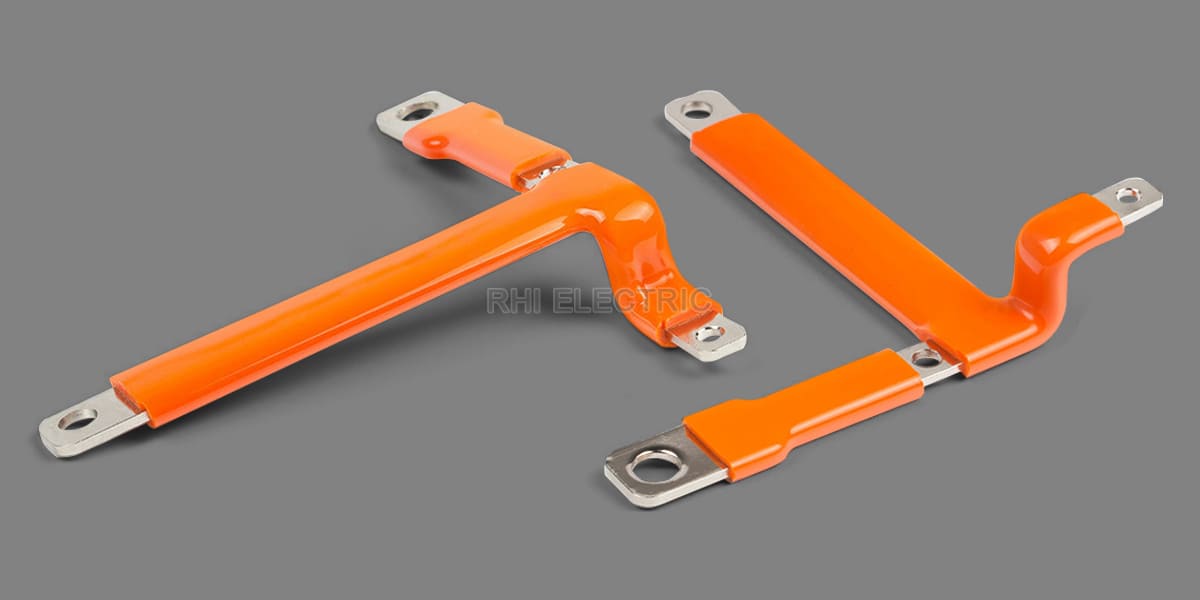
From existing data center upgrades using Sidecar architectures to future AI campuses based on centralized 800V distribution and SST technology, customized copper busbars will play a critical role in building efficient, scalable, and reliable AI computing infrastructure.