


Get Quote


Aluminium Busbar Nickel Plating: A Critical Process for Battery Pack Electrical Connections
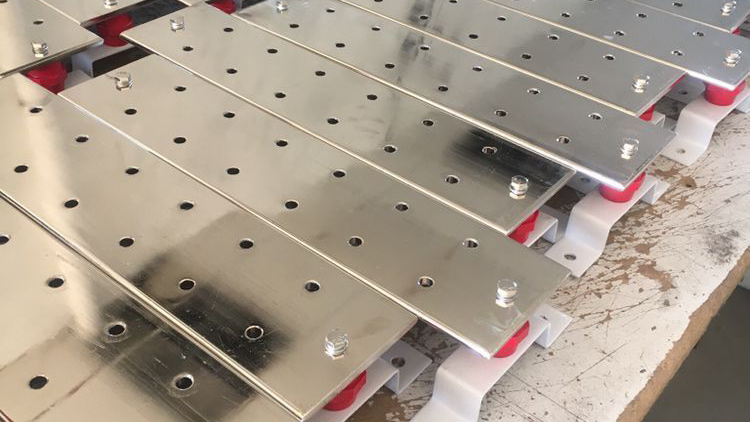
Aluminium busbars are standard for positive and negative output terminals in battery pack modules. In copper-aluminium electrical transition joints, nickel plating on aluminium busbars is nearly mandatory. But anyone who has worked with it knows — aluminium busbar nickel plating is far less forgiving than copper busbar plating.
This article focuses on nickel plating for battery pack aluminium busbars, addressing the three core functional requirements of corrosion resistance, electrical conductivity, and weldability, with emphasis on process control points for double zincating and pre-plating layers, along with corresponding inspection methods.
Why Nickel-Plated Aluminium Busbars for Battery Packs
As conductive connectors within battery packs, aluminium busbars operate under high humidity, vibration, and thermal cycling. Unplated aluminium busbars do not hold up.
Corrosion resistance comes first
The native aluminium oxide (Al₂O₃) film on aluminium surfaces is porous and poorly conductive. Prolonged exposure to moisture or electrolyte environments allows corrosion to propagate along oxide layer defects. Nickel coatings offer high chemical stability and isolate the aluminium substrate from moisture and electrolyte ingress.
Contact stability is equally critical
The aluminium oxide film increases contact resistance. Under high-current charge/discharge conditions, elevated contact resistance generates excessive heat. Nickel coatings provide stable conductivity and ensure low resistance at high current levels.
Joint reliability cannot be compromised
Aluminium exhibits poor weldability and forms brittle intermetallic compounds when joined to copper or steel, resulting in low joint strength. The oxide film also compromises bolted connections and laser welding, leading to potential loose contacts. Nickel layers serve as an effective transition barrier, improving welding and connection performance.
Wear resistance is an added benefit
Pure aluminium has low hardness (approximately 25-35 HB). In vibration-prone battery pack environments, the busbar surface is susceptible to fretting wear. Nickel coatings provide a hardened surface layer that enhances wear resistance.

Where Does the Difficulty Lie
The inherent characteristics of aluminium present the fundamental challenges.
The oxide film is the primary obstacle
Aluminium immediately forms a dense, insulating oxide layer upon air exposure. Direct electroplating over this film yields no metallic bonding between the coating and the substrate — the nickel layer sits "on" the aluminium rather than bonding "into" it.
Potential difference induces displacement reactions
Aluminium has a standard electrode potential of -1.66V versus nickel's -0.25V. This potential differential means that when aluminium is immersed in nickel plating solution, a spontaneous displacement reaction occurs even without applied current, depositing a loose, powdery nickel layer with no adhesion.
A frequently overlooked issue: the narrow process window after zincating
Zincated aluminium busbars must enter the nickel plating bath within one minute; beyond this window, the zinc layer degrades and coating adhesion fails. This tight time constraint demands precise production line control.
Process Approach: Double Zincating as the Critical Differentiator
The core of a robust aluminium busbar nickel plating process lies in double zincating. The distinction between single and double zincating directly determines coating adhesion quality.
Research data demonstrates the difference: single zincating yields an adhesion strength of 10.7 MPa between aluminium and electrodeposited nickel, whereas double zincating achieves 28.5 MPa — a nearly threefold improvement.
The reason: single zincating layers incorporate silicon and other impurities from the substrate, causing localised corrosion when the aluminium enters subsequent plating baths. Double zincating removes the coarse primary zinc layer with nitric acid and redeposits a fine, dense zinc layer on a clean aluminium surface, substantially enhancing adhesion.
Complete process sequence:
Pretreatment: Alkaline degreasing → rinse → alkaline etching → rinse → acid pickling → rinse. This removes oils, contaminants, and the natural oxide film.
Double zincating: First zinc immersion → rinse → zinc stripping → rinse → second zinc immersion → rinse. This is the critical control point. Bath temperature must be maintained at 15-25°C — lower temperatures yield non-uniform zinc layers, while higher temperatures cause the zinc deposit to strip off.
Nickel strike: The zincated workpiece must enter the strike bath within one minute to prevent zinc layer degradation. Strike nickel thickness is typically 0.5-1.5μm.
Main nickel plating: Both electroplating and electroless nickel plating are viable. Electroless nickel offers superior uniformity, particularly suited for complex-shaped busbars. Operating parameters: bath temperature 80-95°C, pH 4.6-4.8, immersion time 3-5 minutes.
Post-treatment: Rinse → drying → (optional passivation).
Technical Specifications and Quality Control
Aluminium busbar nickel plating quality is verified through the following criteria:
Appearance: The nickel deposit must be uniform and bright, free from pinholes, blisters, scratches, or discolouration. Visual inspection is performed under adequate lighting, with 10x magnification for confirmation.
Thickness: Typically controlled at 3-8μm, subject to project-specific requirements. Measurement is performed using eddy current gauges per GB/T 4956 or metallographic cross-section examination.
Adhesion: Cross-cut test per ISO 2409 with 1mm grid spacing; coating detachment ≤5% is acceptable. Thermal shock testing (baking at 220°C followed by rapid quenching) with no blistering or detachment is also commonly employed. Both tests should be conducted at 23±2°C and 50±5% relative humidity, with each test repeated at least three times and averaged.
Corrosion resistance: Neutral salt spray testing per ISO 9227 for 48-96 hours with no evidence of corrosion or exposed aluminium substrate. Test specimens are placed in a chamber at 35°C with 5% sodium chloride solution continuously sprayed. After the test period, specimens are rinsed and dried, then inspected visually for rust or exposed substrate.
Contact resistance: Maximum 5mΩ, measured using the four-point probe method or micro-ohmmeter per GB/T 15519.
Porosity: Maximum 1 pore per cm², measured by the filter paper method using copper sulphate solution for colour development. Filter paper saturated with copper sulphate solution is applied to the plated surface for 30 seconds; red spots indicate pores. Each test is repeated at least three times and averaged.
Industry Trends and Emerging Developments
Global research continues to advance aluminium busbar nickel plating technology.
Norway: A collaborative study between the Norwegian University of Science and Technology and SINTEF conducted 6,000 current cycling tests on bolted aluminium busbars for battery systems. Results showed stable contact resistance of nickel-plated specimens after exposure to salt spray, humidity, and hydrogen sulphide.
United States: Research dates back to 1973, when Bond and McGeary published their foundational paper in IEEE Transactions on Industry Applications on nickel plating for improving aluminium electrical contacts. Braunovic subsequently published multiple studies throughout the 1990s on fretting wear of nickel-plated aluminium conductors, comparing contact resistance of aluminium with nickel, silver, tin, and zinc coatings under fretting conditions.
Germany: The University of Stuttgart, in collaboration with Tongji University and Hefei Gotion High-Tech, quantitatively characterised contact resistance evolution in copper-aluminium electrical joints. Unplated aluminium busbars exhibited resistance increases from initial values to 400-750μΩ under continuous current loading, while nickel-plated counterparts remained stable at approximately 15μΩ.
China: The aerospace sector has developed a combined "double zincating + electroless nickel strike + multilayer nickel electroplating" process, employing rare earth-based electrolytic protection as a replacement for chromate passivation, achieving 168 hours of salt spray resistance.
Aluminium busbar nickel plating demands rigorous control over pretreatment chemistry, adherence to narrow process windows, and precise bath management. Sound double zincating and strict strike-plating timing are prerequisites for producing nickel-plated aluminium busbars that withstand both salt spray exposure and long-term current-carrying service.