

Get Quote


Factors Affecting Copper-Aluminium Busbar Contact Resistance and Control Technologies
Copper-Aluminium Busbar Contact Resistance: Key Factors and Solutions
In power transmission and distribution systems, copper-to-aluminium busbar connections are often unavoidable. Copper offers excellent electrical conductivity but comes at a higher material cost, while aluminium is lighter and more cost-effective, with somewhat lower conductivity. In practical applications, contact resistance at copper-aluminium joints directly affects system power losses, temperature rise, and operational safety. Effective control of contact resistance therefore requires an understanding of the physical mechanisms at the contact interface, followed by systematic control of the key influencing factors.
1. Physical Nature of Copper-Aluminium Busbar Contact Resistance
Although two metal busbars may appear to be in full contact macroscopically, their surfaces contain numerous microscopic peaks and valleys. Actual physical contact occurs only at a limited number of microscopic asperities, and the true contact area represents only a small fraction of the apparent contact area. As current is forced through these narrow conductive paths, the current lines constrict, producing constriction resistance.
At the same time, metal surfaces inevitably contain oxide films and contaminants. Aluminium readily forms a dense aluminium oxide (Al₂O₃) film when exposed to air. Although this film is only a few nanometers thick, it has very high electrical resistance and is chemically stable, creating an additional barrier to current flow.
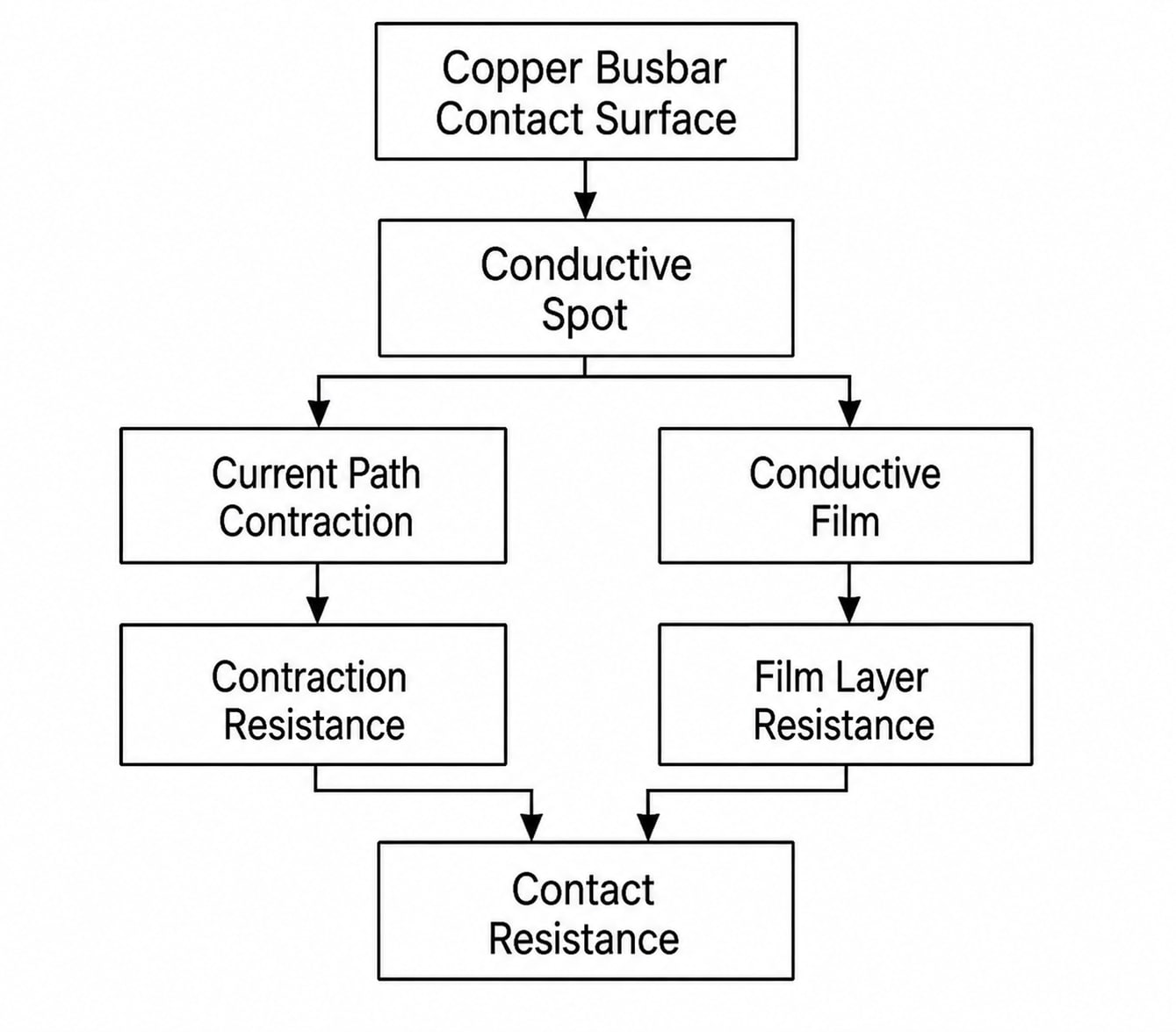
Therefore, contact resistance can generally be understood as the combined effect of:
Contact Resistance = Constriction Resistance + Film Resistance
These two components jointly determine the electrical losses and temperature-rise characteristics of the connection.
2. Key Factors Affecting Copper-Aluminium Busbar Contact Resistance
2.1 Contact Pressure
Contact pressure is one of the most effective engineering variables for controlling contact resistance. Increasing the clamping force enlarges the actual contact area by deforming microscopic surface asperities. It can also disrupt relatively thin oxide films and promote direct metal-to-metal contact.
This is one of the primary reasons why properly torqued bolted joints are widely used for busbar connections. However, the specified tightening torque must be controlled within the design range to ensure adequate and stable contact pressure without damaging the joint.
2.2 Surface Condition
The effect of surface condition is more complex than it may initially appear. An excessively smooth surface is not necessarily beneficial. When contact pressure is insufficient, a highly smooth surface may provide fewer high-pressure contact points capable of penetrating surface films. Under certain conditions, a properly prepared surface with controlled roughness can provide more effective electrical contact.
Different surface treatments—including polishing, oxidation, and plating—can therefore produce significant differences in contact resistance.
2.3 Material and Environmental Conditions
Material properties and environmental conditions strongly influence the long-term stability of contact resistance. Aluminium has a resistivity approximately 1.6 times that of copper and is mechanically softer. Under sustained compressive loading, aluminium is susceptible to creep, which can gradually reduce bolt preload and increase contact resistance.
As temperature increases, the resistivity of metals generally rises. Elevated temperature can also accelerate surface oxidation and degradation. High humidity and the presence of electrolytes can further promote galvanic corrosion at copper-aluminium interfaces.
2.4 High-Frequency Effects
For high-frequency current transmission, the skin effect must also be considered. As frequency increases, current tends to concentrate toward the conductor surface, making surface condition and surface treatment increasingly important. Under such conditions, resistance cannot be accurately evaluated using DC resistance calculations alone; AC resistance and frequency-dependent effects must also be considered.
3. Specific Risks of Copper-Aluminium Connections
Copper-aluminium joints present greater long-term reliability challenges than connections between the same metals, primarily because several mechanisms can act simultaneously.
3.1 Galvanic Corrosion
Galvanic corrosion is one of the major risks. Copper and aluminium have significantly different electrochemical potentials. In the presence of moisture or an electrolyte, a copper-aluminium contact can form a galvanic couple, with aluminium acting as the more active metal and being preferentially corroded.
Corrosion products and surface degradation can increase the resistance of the interface, while the resulting deterioration can further compromise mechanical contact and accelerate electrical degradation.
3.2 Differential Thermal Expansion
Copper and aluminium also have different coefficients of thermal expansion. Copper has a coefficient of approximately 17 × 10⁻⁶/°C, while aluminium is approximately 23 × 10⁻⁶/°C.
During repeated load cycles, the resulting difference in thermal expansion and contraction can introduce relative movement and mechanical stress at the interface. Over time, this can contribute to surface wear, loss of contact pressure, and an increase in contact resistance.
3.3 Positive Feedback Between Heating and Corrosion
These effects can interact in a self-reinforcing cycle:
Corrosion → Higher Contact Resistance → Increased Heat Generation → Accelerated Degradation → Further Increase in Resistance
If left uncontrolled, progressive resistance growth can lead to excessive temperature rise, joint damage, and, in severe cases, electrical failure or fire.
For this reason, long-term reliability of copper-aluminium joints depends not only on achieving low initial contact resistance, but also on maintaining stable mechanical pressure and protecting the interface against environmental degradation.

4. Engineering Measures for Reducing Copper-Aluminium Contact Resistance
4.1 Proper Contact Pressure
Applying and maintaining the specified clamping force is the first and most direct method of reducing contact resistance.
Bolted connections should be tightened to the specified torque and provided with appropriate anti-loosening measures where required. Because aluminium is susceptible to creep and stress relaxation, joint design should account for potential preload loss. Spring washers, Belleville washers, or other suitable preload-maintaining solutions may be considered depending on the application and applicable standards.
4.2 Surface Preparation and Protection
Surface preparation is a basic requirement before making a copper-aluminium connection. Oil, dirt, loose oxide, and other contaminants should be removed from the contact surfaces.
Because aluminium reforms an oxide film rapidly after surface preparation, the joint should be assembled promptly or protected with a suitable conductive joint compound or other approved protective treatment.
Conductive joint compounds can help exclude moisture and oxygen from the interface and reduce further oxidation. Their compatibility with the specific materials, plating system, and operating conditions should be verified before use.
4.3 Special Plating Processes for Aluminium Busbars
Aluminium requires specialized pretreatment before electroplating and cannot generally be plated directly in the same manner as copper.
Because of the stable aluminium oxide film and the electrochemical behavior of aluminium, direct plating can result in poor adhesion and unreliable coating performance. A typical process may therefore include zincate treatment to remove or displace the oxide layer and form an intermediate zinc layer, followed by a copper or nickel strike as a barrier/intermediate layer before applying the final silver or tin plating.
The specific pretreatment and plating sequence should be selected according to the aluminium alloy, coating system, application environment, and applicable process specifications.
4.4 Copper-Aluminium Transition Materials and Metallurgical Bonding
Using a copper-aluminium transition component with a metallurgically bonded interface provides a more robust approach to controlling the risks associated with direct copper-aluminium contact.
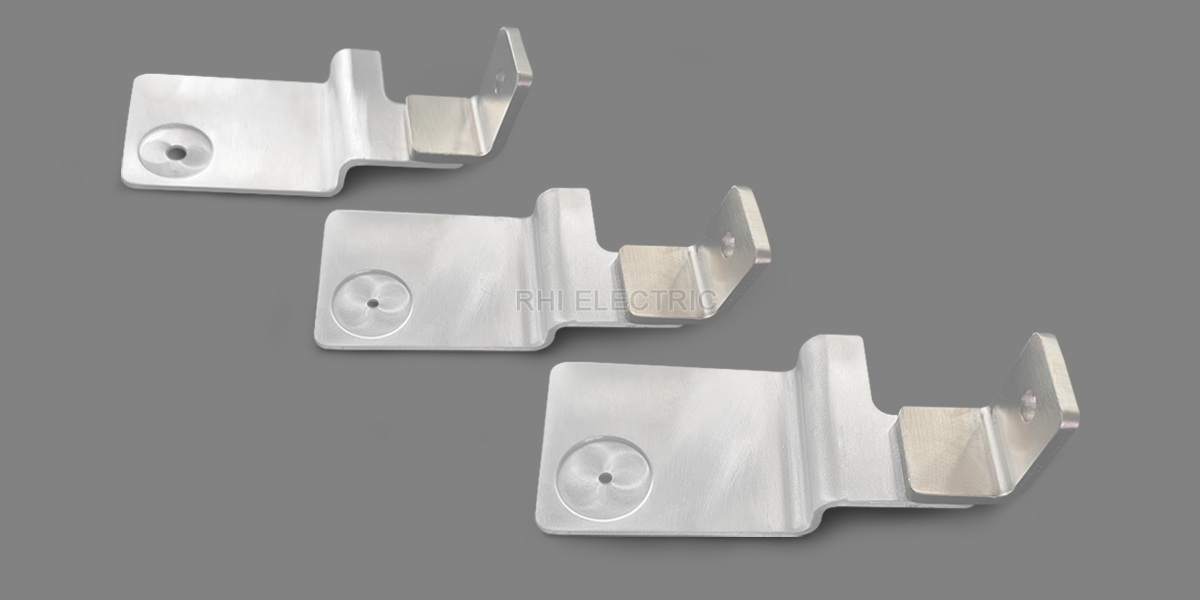
Solid-state joining technologies can create a metallurgical bond between copper and aluminium while minimizing reliance on a conventional bolted interface. By separating the copper and aluminium conductive sections through a properly engineered transition zone, the design can significantly reduce the risk of galvanic corrosion and provide more stable electrical and mechanical performance.
For production applications, key performance indicators should be validated through appropriate testing, including interface contact resistance, mechanical strength, thermal performance, and environmental durability.
5. RHI Copper-Aluminium Busbar Manufacturing and Process Validation
Based on its manufacturing experience and process development capabilities, RHI has developed multiple joining processes for copper-aluminium busbar applications.
For dissimilar-metal joining between T2 copper and 6-series aluminium alloys, RHI supports three core process routes:
- Diffusion brazing
- Solid-state atomic bonding
- Friction stir welding (FSW)
These processes use a T2 copper + 6-series aluminium + T2 copper sandwich structure.
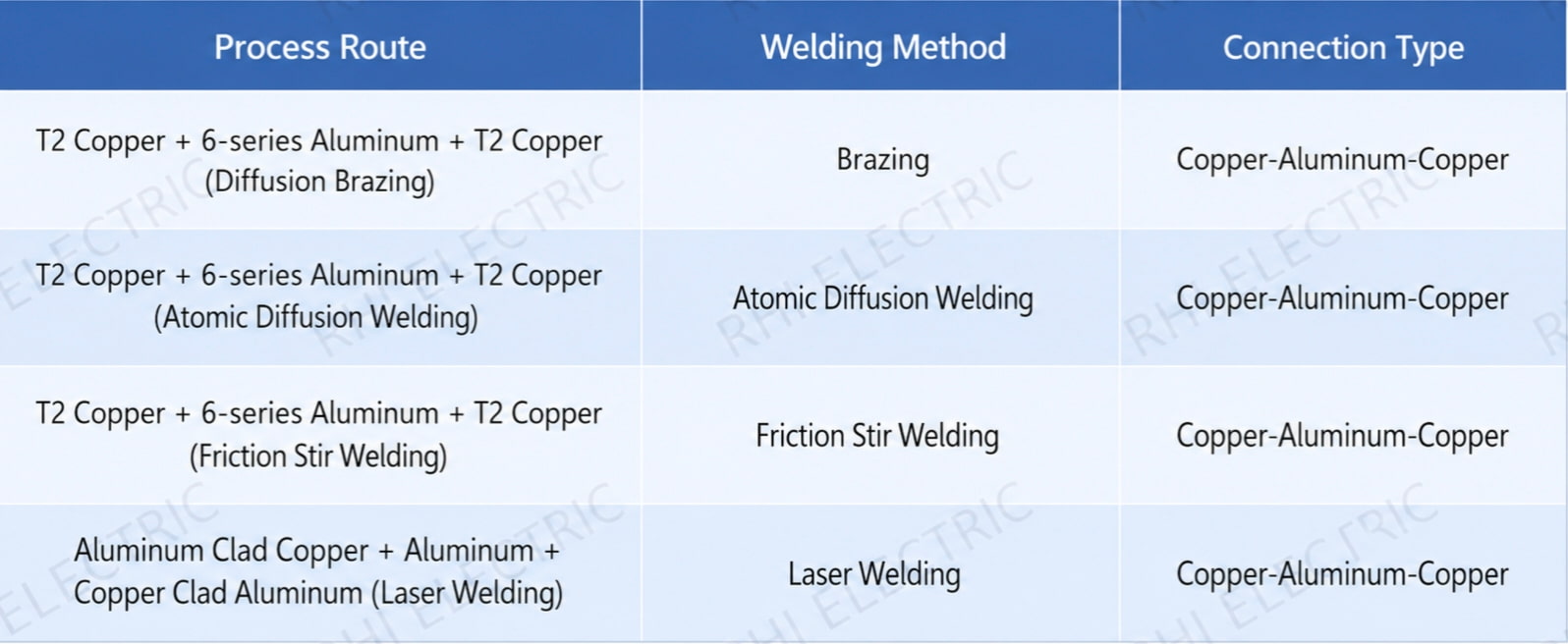
RHI also supports a laser-welding process using a copper-aluminium transition material + aluminium + copper-aluminium transition material configuration. This provides flexibility in selecting the appropriate joining method according to application requirements, structural design, production volume, and cost considerations.
Key Performance Tests
Finished copper-aluminium welded busbars are subject to key performance evaluations in accordance with applicable industry and customer requirements:
Contact Resistance Test
Evaluates the electrical conductivity of the bonded interface and verifies that temperature rise under rated current remains within the specified limits.
Pull-Off / Tensile Strength Test
Evaluates the mechanical strength of the bonded interface and verifies its ability to withstand mechanical loads and vibration during long-term operation.
Bend Test
Evaluates the ductility and crack resistance of the welded area and assesses the effect of the joining process on the mechanical integrity of the materials and interface.
Copper-aluminium welded busbars manufactured using RHI's various process routes have passed the above key performance evaluations, providing a basis for engineering and volume applications.
From high-voltage switchgear to copper-aluminium terminals and interconnects in new energy battery systems, RHI provides copper-aluminium connection solutions with process options tailored to different electrical, mechanical, and manufacturing requirements.